general MCP Server
World's first local-only AI memory to break 74% retrieval and 60% zero-LLM on LoCoMo. No cloud, no APIs, no data leaves your machine. Additionally, mode C (LLM/Cloud) - 87.7% LoCoMo. Research-backed. arXiv: 2603.14588
Discovered via github-seeds:mcp-hot and last synced 3mo ago.
1. Install the package
npx superlocalmemory
2. Add to claude_desktop_config.json
{
  "mcpServers": {
    "superlocalmemory": {
      "command": "npx",
      "args": [
        "superlocalmemory"
      ]
    }
  }
}
Config file location: ~/Library/Application Support/Claude/claude_desktop_config.json (macOS) / %APPDATA%\Claude\claude_desktop_config.json (Windows)
70.3%
Size
V3.0
Yes
Clean orphaned SLM processes
5
Score
93.05%
Partial
Extract and store patterns from memory clusters
Retrieve auto-learned patterns for context injection
18
Better answers, data stays local
Maximum accuracy, research
Impact
Version
To the best of our knowledge, **no existing agent memory system addresses EU AI Act compliance**. Modes A and B pass all checks by architectural design — no personal data leaves the device during any memory operation. Built-in compliance tools: GDPR Article 15/17 export + complete erasure, tamper-proof SHA-256 audit chain, data provenance tracking, ABAC policy enforcement. --- ## Multilingual Embedding Support **v3.4.24+:** Plug in any OpenAI-compatible embedding endpoint — Ollama, vLLM, LiteLLM, or self-hosted models like `bge-m3`, `multilingual-e5`, `Qwen3-Embedding`. Configure from the dashboard (Settings > Step 3) or `config.json`. SLM's math layer (Fisher-Rao, Sheaf, Langevin) is language-agnostic — swap the embedding model and all 30+ languages work at full retrieval quality. No cloud dependency. No code changes. Your data, your language, your model. --- ## Web Dashboard ```bash slm dashboard # Opens at http://localhost:8765 ``` **v3.4.4 "Neural Glass":** 17-tab sidebar dashboard with light + dark theme. Knowledge Graph (Sigma.js WebGL, community detection), Health Monitor, Entity Explorer (1,300+ entities), Mesh Peers (P2P agent communication), Ingestion Status (Gmail/Calendar/Transcript management), Privacy blur mode. Always-on daemon with auto-start. 8 mesh MCP tools built-in. Cross-platform: macOS + Windows + Linux. All data stays local. <!-- UX-M1: link dashboard-coverage so users can find deferred Living Brain Evolution tiles --> > **Living Brain Evolution visibility:** v3.4.21 ships the reward model, shadow test + online retrain, and evolution cost log via the REST API and `slm status --json`; the dedicated dashboard tiles are deferred to the next cycle. See [docs/DASHBOARD-COVERAGE.md](docs/DASHBOARD-COVERAGE.md) for endpoints and workarounds. --- <details> <summary><strong>Active Memory (V3.1) — Memory That Learns</strong> (click to expand)</summary> Every recall generates learning signals. Over time, the system adapts to your patterns — from baseline (0-19 signals) → rule-based (20+) → ML model (200+, LightGBM trained on YOUR usage). Zero LLM tokens spent. Four mathematical signals computed locally: co-retrieval, confidence lifecycle, channel performance, and entropy gap. Auto-capture hooks: `slm hooks install` + `slm observe` + `slm session-context`. MCP tools: `session_init`, `observe`, `report_feedback`. **No competitor learns at zero token cost.** </details> --- ## Features ### Retrieval - 5-channel hybrid: Semantic (Fisher-Rao) + BM25 + Entity Graph + Temporal + Hopfield (associative / partial-query completion) - RRF fusion + cross-encoder reranking - Agentic sufficiency verification (auto-retry on weak results) - Adaptive ranking with LightGBM (learns from usage) - Hopfield completion for vague/partial queries ### Intelligence - 11-step ingestion pipeline (entity resolution, fact extraction, emotional tagging, scene building) - Automatic contradiction detection via sheaf cohomology - Adaptive memory lifecycle — memories strengthen with use, fade when neglected - Smart compression — embedding precision adapts to memory importance (up to 32x savings) - Cognitive consolidation — automatic pattern extraction from related memories - Auto-learned soft prompts injected into agent context - Behavioral pattern detection and outcome tracking ### Skill Evolution - **Per-skill performance tracking** — tracks which skills succeed and fail across sessions (zero-LLM, always on) - **Evolution engine** — 3-trigger system with blind verification. Off by default — enable via `slm config set evolution.enabled true` - **MCP tools** — `evolve_skill`, `skill_health`, `skill_lineage` for programmatic access - **Lineage DAG** — visual evolution history in the dashboard - **CLI config** — `slm config get/set` for all evolution settings - **Post-session triggers** — automatic analysis on session end via Stop hook - **[ECC](https://github.com/affaan-m/everything-claude-code) integration** — optional enhanced observations via `slm ingest --source ecc` ### Tiered Storage & Scaling - **4-tier lifecycle** — active, warm, cold, archived with automatic promotion/demotion - **Deep recall** — archived facts searchable at reduced weight - **Graph pruning** — automatic cleanup of orphan edges, self-loops, duplicates - **Fact consolidation** — clusters related facts into consolidated summaries ### Trust & Security - Bayesian Beta-distribution trust scoring (per-agent, per-fact) - Trust gates (block low-trust agents from writing/deleting) - ABAC (Attribute-Based Access Control) with DB-persisted policies - Tamper-proof hash-chain audit trail (SHA-256 linked entries) ### Infrastructure - 17-tab web dashboard with real-time visualization - 17+ IDE integrations (Claude, Cursor, Windsurf, VS Code, JetBrains, Zed, etc.) - 33 default MCP tools (+42 optional via `SLM_MCP_ALL_TOOLS=1`) + 7 MCP resources - Profile isolation (independent memory spaces) - 2,900+ tests, AGPL v3, cross-platform (Mac/Linux/Windows) - CPU-only — no GPU required - Automatic orphaned process cleanup --- ## CLI Reference
6
Use
80.0%
--- ## Contributing See [CONTRIBUTING.md](CONTRIBUTING.md) for guidelines. [Wiki](https://github.com/qualixar/superlocalmemory/wiki) for detailed documentation. ## License GNU Affero General Public License v3.0 (AGPL-3.0). See [LICENSE](LICENSE). For commercial licensing (closed-source, proprietary, or hosted use), see [COMMERCIAL-LICENSE.md](COMMERCIAL-LICENSE.md) or contact [email protected]. Copyright (c) 2026 Varun Pratap Bhardwaj / Qualixar. ## Attribution Part of [Qualixar](https://qualixar.com) · Author: [Varun Pratap Bhardwaj](https://varunpratap.com) ### Acknowledgments - **[Everything Claude Code (ECC)](https://github.com/affaan-m/everything-claude-code)** — SLM's skill observation patterns were inspired by ECC's continuous learning architecture. SLM supports direct ingestion of ECC observations via `slm ingest --source ecc`, giving ECC users richer skill performance tracking. We recommend ECC for Claude Code users who want the deepest learning experience alongside SLM. - **[HKUDS/OpenSpace](https://github.com/HKUDS/OpenSpace)** — The skill evolution research in SLM draws from the EvoSkills co-evolutionary verification concepts (arXiv:2604.01687). We adopted their 3-trigger evolution system and anti-loop guard patterns. --- <p align="center"> <sub>Built with mathematical rigor. Not in the race — here to help everyone build better AI memory systems.</sub> </p> --- ## ⭐ Support This Project If this project solves a real problem for you, **please star the repo** — it helps other developers discover Qualixar and signals that the AI agent reliability community is growing. Every star matters. [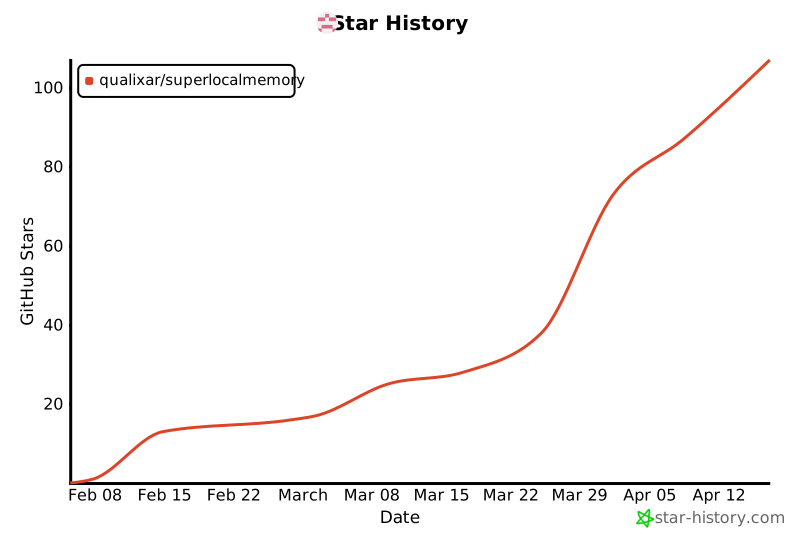](https://star-history.com/#qualixar/superlocalmemory&Date) --- ## Part of the Qualixar AI Agent Reliability Platform Qualixar is building the open-source infrastructure for AI agent reliability engineering. Seven products, seven research papers (published as arXiv preprints + Zenodo archives), one coherent platform. Each tool solves one reliability pillar:
Score
Trigger smart compression on demand
17
What
64.2%
Programmatic memory archival via lifecycle rules
26
`slm recall "auth"` (readable text output)
78.5%
Description
33
Auto-configured for 17+ IDEs via `slm connect`
With Math
Install
Memory lifecycle analytics
29
72.0%